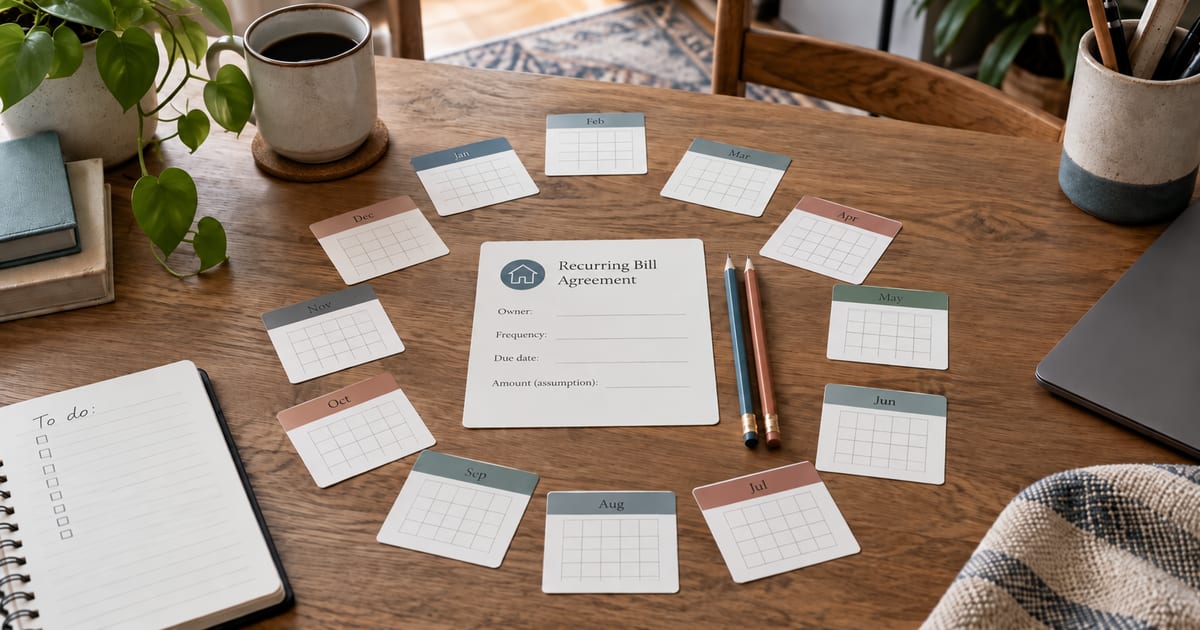
Setting Up a Recurring Household Bill Agreement
Turn a recurring household cost into a clear planning agreement with the right owner, frequency, dates and amount assumptions.
A recurring bill becomes easier to manage when the household writes down the arrangement behind it. Who supplies the service? Is it shared or personal? When is a charge normally raised? Is the amount fixed, variable or made up of several parts?
That planning record is a household bill agreement. It does not replace the provider's contract and it does not pay anything. It gives the people in the home one clear set of assumptions from which future bills can be organised.
Begin with the provider evidence
Use the contract, latest statement and provider account rather than memory. Confirm:
- the provider and service name;
- the account holder;
- the billing frequency;
- the usual statement and payment timing;
- the current price or method used to calculate it;
- the start date and any known end date; and
- any notice about a coming change.
Keep the legal contract and the household's internal arrangement separate. If one person's name is on a utility account, a private decision to split the cost does not transfer the provider's rights or obligations. For households in England, Citizens Advice notes that the person whose name is on a utility bill is responsible for it, while a jointly named account may leave each named person exposed to an outstanding balance (Citizens Advice on shared accommodation). Check the contract and rules that apply where you live.
The household agreement should help everyone coordinate without pretending to rewrite those terms.
Decide whether the cost is household or personal
Ask who benefits from the service and what the household has actually agreed to share. Rent, broadband or a communal service may be household costs. An individual subscription or private insurance policy is usually personal, even if it is paid from an account also used for shared spending.
Write the scope explicitly. Do not let the payment account make the decision by accident.
For a personal agreement, name its owner. For a household agreement, record any relevant members or line-item assignments without assuming that the person who administers the provider account must permanently fund everyone else's share.
If the household later changes its mind about scope, treat that as a new decision. Preserve the bills already recorded under the old arrangement so earlier months still make sense.
Choose fixed or variable deliberately
A fixed agreement has a dependable planning amount. Examples might include €38 for broadband or €24 for a subscription. Record the confirmed amount, but still review it when a discount ends or a renewal notice arrives.
A variable agreement describes a recurring service whose actual charge must be taken from each bill. Energy, water or usage-based services often fit this pattern. You may keep an estimate for planning, but label it as an estimate and replace it with the real charge when the statement arrives.
Do not force a changing service into a fixed amount because it makes the budget look tidy. Equally, do not call a genuinely fixed contract variable merely because one transitional bill contains a credit or part-month adjustment.
If affordability is already a problem, an agreement is not a solution by itself. Contact the provider early and use independent money guidance for priority bills and debt support.
Set the frequency and starting month
Use the frequency in the provider arrangement: monthly, quarterly, twice yearly or yearly. For anything less frequent than monthly, record the month in which the cycle begins.
Suppose insurance costs €720 each year in September. The agreement should remain yearly with a September start. Dividing it into a €60 monthly saving target can help the household prepare, but it must not create twelve fictional provider bills.
For a quarterly €150 service beginning in February, expected charge months would be February, May, August and November. Check the actual contract because “every three months” can behave differently after a delayed first bill or a provider change.
The agreement is a schedule for attention. It is not a promise that a statement will arrive on time or for the expected amount.
Record dates that answer different questions
Three dates often matter:
- Start date: when the arrangement begins.
- Raised day: the usual day in the cycle when a bill is issued.
- Payment terms: the number of days between issue and the expected payment date.
An end date matters when the agreement is inactive or a contract has a confirmed finish. Do not invent one merely because the household intends to review the service.
Keep these dates separate from the date money actually leaves an account. A statement raised on the 8th with fourteen-day terms may be due on the 22nd, while a direct debit could clear on another confirmed date.
MoneyHelper explains that a Direct Debit lets a company collect an agreed bill and may handle changing amounts, while a standing order sends a fixed amount chosen by the account holder (MoneyHelper on Direct Debits and standing orders). Neither payment method changes what the underlying bill agreement should record.
Choose one amount structure
A simple fixed service may need one default total. A more complicated agreement may be clearer as line items.
Imagine a shared service with:
- base plan: €50;
- equipment rental: €8; and
- an individual add-on: €12.
The subtotal is €70. If the household excludes the personal add-on from the shared calculation, the shared total is €58. Retain the €12 line so the provider statement can still be reconciled, but mark why it is excluded and who owns it.
Do not enter both a €70 default total and the same €70 of line items as separate costs. Choose the representation that explains the bill. Check that included and excluded items match the provider's arithmetic.
For a variable agreement, avoid filling line items with invented future values. Use the actual bill when it arrives, especially where usage or fees change.
Give the agreement an owner and a review point
Ownership means responsibility for maintaining the record: checking provider notices, confirming the actual bill and raising questions with the household. It does not automatically decide who pays or how the cost is split.
Set a practical review trigger:
- one month before a fixed term ends;
- when a promotional price expires;
- when the provider announces a change;
- when someone joins or leaves the household; or
- after an unexpectedly different bill.
Do not cancel a payment instruction and assume the service contract has ended. MoneyHelper warns that cancelling a Direct Debit or standing order stops that payment method but does not cancel the underlying contract (MoneyHelper payment guidance). Contact the provider and keep its confirmation.
How Billum supported agreements at publication
As at 28 April 2026, Billum let an authenticated household create an agreement linked to a saved recipient and category. The form supported Household or Personal scope, Fixed or Variable cost type, active status, monthly, quarterly, twice-yearly or yearly frequency, a cycle start month, start and end dates, a raised day and payment terms.
An agreement could use a default total or itemised amounts. Household line items could be assigned to members or excluded from the shared total. The agreement could then be viewed, edited or removed, and future bills could be based on its recurring setup.
Billum did not sign a provider contract, collect a Direct Debit, prove that a bill had been issued or guarantee that a future bill would match the plan. The API also revalidated references and agreement details when saving. Provider evidence remained authoritative.
This setup guide is deliberately different from keeping household bill agreements up to date. First establish a reliable agreement; use the change routine later when the provider, amount, dates or household circumstances move.
Use a final setup checklist
Before saving an agreement, confirm that:
- the recipient identifies the correct provider;
- the scope reflects an explicit household decision;
- fixed or variable matches how the charge behaves;
- the frequency and starting month match the contract;
- start, end and bill timing are evidence-based;
- the amount or line items reconcile; and
- someone owns the next review.
A good recurring agreement is modest and precise. It records what the household expects, keeps responsibility visible and makes the next real bill easier to check without pretending that planning and payment are the same thing.
Open Billum to set up one recurring household bill agreement from verified provider details.