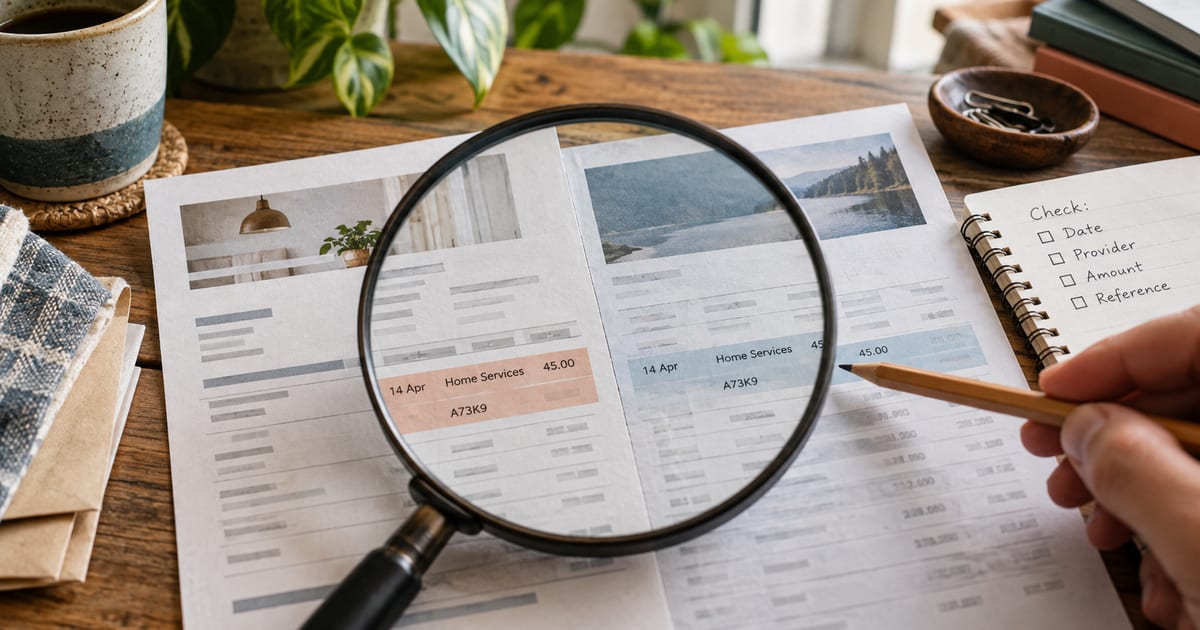
Is That Household Charge a Duplicate?
A practical way to compare dates, providers, totals and line items before deciding whether a household charge has really been recorded twice.
Two entries with the same provider and amount can look like an obvious duplicate. Sometimes they are. Sometimes one is an invoice and the other is its payment, two similar charges cover different periods, or a pending card entry later becomes final. Deleting one immediately can hide a real cost just as easily as leaving a genuine duplicate can inflate the household total.
The safer approach is to investigate the pair as a small evidence problem. Compare the source records, establish what each entry represents and change the household record only when the explanation is clear.
This guide gives you a repeatable way to do that. It works with paper, a spreadsheet or a budgeting app, and it does not depend on automatic duplicate detection.
Start by describing the suspected pair
Write the two entries side by side. Capture the provider or merchant, amount, transaction or bill date, due date, account used and any reference shown on the statement or invoice.
Do not decide from the amount alone. A €46 broadband bill can repeat each month. Two €46 entries may therefore be expected recurring bills, a bill plus the matching bank debit, or two collections for the same period.
Mark where each entry came from:
- provider invoice or online account;
- bank or card statement;
- household bill list;
- receipt or order confirmation; or
- transfer between household members.
The source matters because these records describe different events. An invoice says an amount was requested. A bank entry says money moved. A reimbursement says money moved between people. They should not automatically become three separate household costs.
MoneyHelper recommends having bills, bank statements and banking information available when checking a budget because accurate source figures make the result more realistic (MoneyHelper Budget Planner). The same principle applies to a duplicate investigation: compare evidence rather than relying on memory.
Check whether the dates describe the same event
Dates often explain an apparent duplicate. Compare:
- the service or billing period;
- the date the provider raised each bill;
- the due date;
- the date money left the account; and
- the date the transaction was posted or settled.
A bill raised late in one month may be due in the next. A card transaction may appear first as pending and then as completed. A recurring service may also produce identical amounts on consecutive billing dates.
Group records by the period they cover, not merely the month in which you noticed them. If two invoices both say they cover 1–30 June, that supports further investigation. If one covers May and the other June, the matching amount is probably coincidence rather than duplication.
Keep the distinction visible while you check. Label the entries “suspected duplicate” instead of deleting or marking either one as resolved.
Compare provider, reference and account
Names on different records may not match exactly. The invoice might show a familiar brand while the statement uses a legal company name or abbreviated payment description. Confirm identity using the provider account, invoice number, payment reference, website and the last digits of the paying account where appropriate.
Then ask whether the two entries represent the same direction of money:
- two debits from the same account may indicate a repeated collection;
- one invoice and one debit may be the expected request-and-payment pair;
- one debit and one household reimbursement may represent one cost and its internal settlement; and
- a debit followed by a credit may show a reversal rather than a second cost.
Do not treat a transfer between household members as another provider charge. If Alex pays a €72 bill and Sam transfers €36 to Alex, the household cost remains €72. The €36 transfer changes who ultimately funded it; it does not increase what the provider charged.
Reconcile the itemisation, not only the headline total
If invoices or receipts are available, compare their line items. Two totals can match even when the underlying charges differ, and two different totals can still contain the same duplicated line.
Check descriptions, quantities, service dates, discounts, fees, credits and taxes. Add the lines independently and make sure they reconcile to the source total. For example, one €84 invoice might contain a €60 service, €18 equipment charge and €6 fee. Another €84 invoice might contain a new period of service plus a credit and usage adjustment. The shared total alone cannot tell you whether they are duplicates.
Use three labels during the review:
- confirmed once: supported by one distinct invoice or purchase;
- possible duplicate: two records may describe the same external charge; and
- explained pair: related records describe different events, such as invoice and payment.
This prevents an unresolved question from silently becoming a correction.
Decide which record, if any, needs correction
Once the evidence is clear, choose the narrowest correction.
If the provider charged only once but the household record contains two copies, remove or correct the extra internal record. Keep a short note of what was changed and why. If the provider or bank statement contains two completed debits, do not “fix” the external problem by deleting one from the household view. Preserve both entries and contact the provider or payment firm through its official route.
MoneyHelper includes being charged multiple times among the payment problems to raise with the company first, followed by the bank if the company cannot resolve it (MoneyHelper on sorting out a payment problem). Exact rights, deadlines and dispute processes depend on the payment method and country, so use the instructions supplied by your provider rather than a generic household rule.
Keep copies of the invoice, statement and correspondence. Record the date you reported the problem, any case number and whether a temporary or final credit appears. A refund is a correction to the original cost, not new household income.
How Billum supports a manual check
Billum's current Merchant History view is built from the household's saved bills. For each merchant, it displays the number of bills, their total, their average amount and the latest bill amount and due date. That gives a useful starting point for spotting an unexpected count or comparing a suspicious amount with the merchant's normal pattern.
The bills view shows each saved bill's merchant, amount, category, raised date, due date and paid status. Where a bill uses line items, the card also shows their descriptions and amounts, including excluded or member-assigned lines. A household can therefore compare the suspected records and their itemisation before editing or deleting anything.
Billum does not automatically identify duplicate charges, inspect a bank account, match a debit to an invoice, contact a provider or decide that a charge is invalid. Merchant History is a summary rather than a dedicated duplicate-finding report. The source statement and provider evidence remain authoritative.
Use a short duplicate-check routine
When a charge looks repeated, work through this order:
- Save both entries without changing them.
- Record the amount, provider, dates, reference and source of each.
- Confirm the billing or purchase period.
- Decide whether the entries are both costs or different stages of one cost.
- Compare the underlying line items and totals.
- Ask another household member whether they recognise either entry.
- Correct only the household record when the duplication exists there.
- Contact the provider promptly when the external statement itself appears wrong.
- Record any refund against the original cost.
Keep the conversation factual. MoneyHelper suggests giving people notice before a money discussion, including those involved and writing down next steps (MoneyHelper's guide to money conversations). A neutral summary such as “these two €46 entries may cover the same period; let us compare the invoices” is more useful than assuming somebody made a mistake.
The aim is not to make two similar lines disappear. It is to understand what each line represents. Once dates, source documents and itemisation agree, you can correct a genuine duplicate without erasing a legitimate household cost.
If the records differ only because one provider appears under several labels, use the merchant-name clean-up workflow instead of deleting a valid transaction.